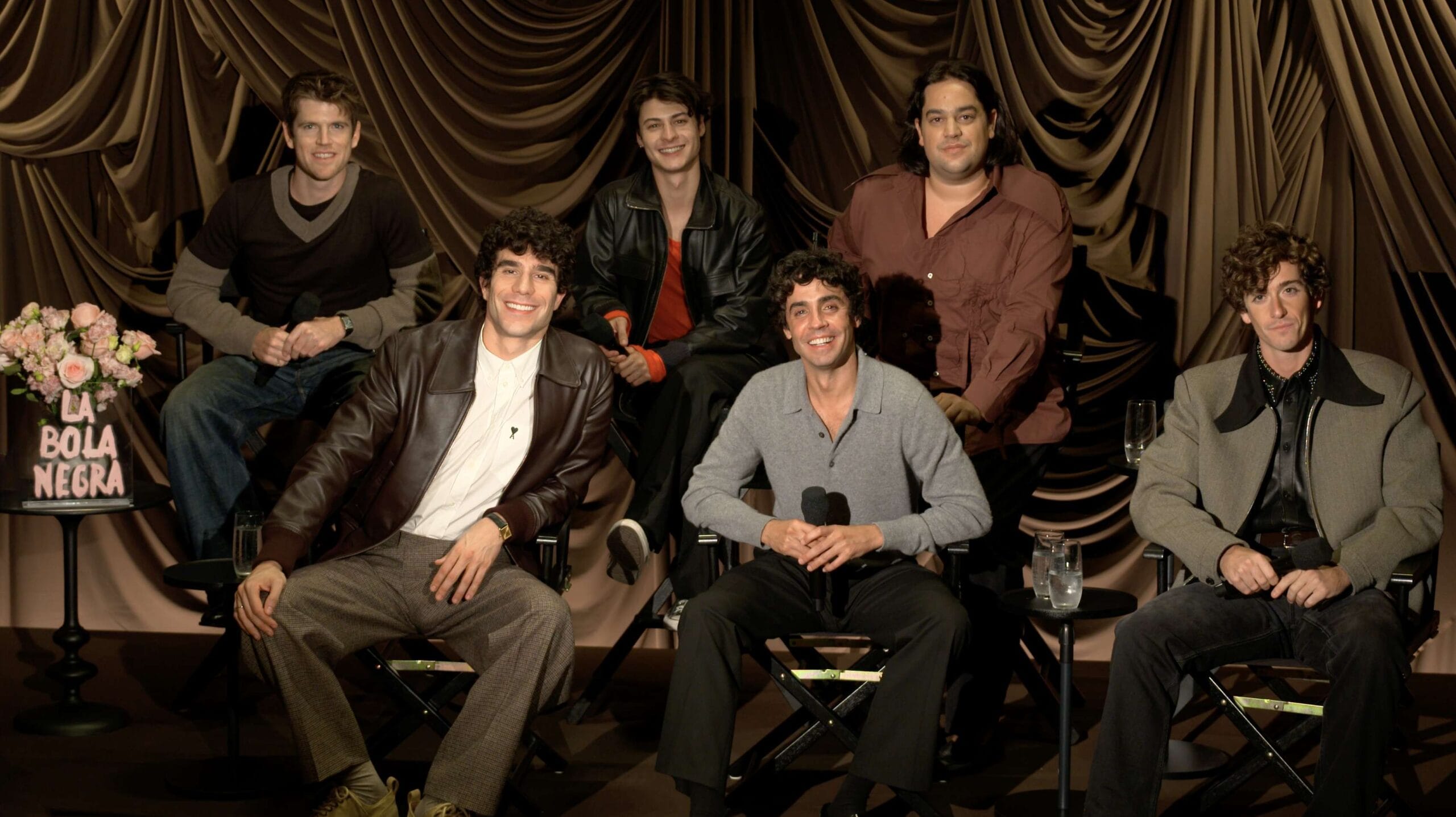
La Bola Negra directors Javier Ambrossi and Javier Calvo, known together as Los Javis, joined stars Guitarricadelafuente, Miguel Bernardeau, Milo Quifes and Carlos González for a private Netflix press conference at the Toronto International Film Festival (TIFF), discussing the film’s scale, its roots in an unfinished Federico García Lorca play, and its recent Best Director win at Cannes.
Why did Los Javis want to make an “epic” queer drama?
Asked why the film’s scale mattered, Ambrossi explained that the project began as an adaptation of a much smaller, more intimate play before growing into something bigger. “It’s funny that it’s based on a play called La Piedra Oscura that is only about the relationship between Sebastian and Rafael. And the play is so intimate and so delicate and so… that it’s only the conversations between them. So it’s funny that finally the adaptation of that play became this movie.”
Ambrossi said adding Lorca’s unfinished fragment, titled La Bola Negra, along with their own present-day perspective, reframed the project entirely. “We understood it’s the story of our grandfathers, our grandparents. So we thought we had to do it big, you know? It’s a tribute to the LGBTQ+ community that fought before us. So we wanted to make it big. And I don’t want to be told that our stories should be niche. I know I don’t want to be told that our stories are not universal.”
Calvo added that their approach to depicting war was informed by anti-war films rather than romanticized ones: “My favorite war movies are Come and See or Apocalypse Now or Ivan’s Childhood by Tarkovsky. They’re really harsh movies and realistic movies and movies that has — they have pain and poetry, but they’re not movies that romanticize war… it’s a movie about empathy and humanity and seeing the other as a person.”
How did Los Javis piece together Lorca’s unfinished play?
The film’s script grew out of just four surviving pages Lorca left behind before his 1936 assassination. Calvo described treating the material almost like detective work: “In the four pages that were found of La Bola Negra, we have in the first page the names of the characters. So we have the father, the mother, Enrique, Lorenzo. But then suddenly you get more magical, and then it’s the skiers, the snow.”
Calvo said the process involved years of research alongside Alberto Conejero, a Lorca expert who co-wrote the film. “We worked with Alberto Conejero, who’s an expert on Lorca, and we got obsessed with his work. Like, we read every Federico’s play like 100 times. I read all his letters, all his biographies, and we were trying to connect with what he wanted to do… We also went with the family of Federico to see the foundation and see the original pages. It was years of working.”
Carlos González, who plays Alberto in the film, recalled the intensity of that research process through an interpreter: “I remember seeing Javi with this big fat book of all of the works of Federico Garcia Lorca absolutely destroyed, underlined everywhere just completely worn and sometimes we’d be on the train and we’d just break into performance just going through this whole process.”
What does ‘La Bola Negra’ say about love?
Ambrossi said the film is ultimately about love withheld across generations. “It is a movie about love without love. I guess that’s what we were trying to do. Like everyone deserves to be free and to find love.” He described how each of the film’s three timelines represents a different stage of that repression, from a character in 1932 who “is not able even to say, yes, I am,” to a present-day character who, despite living freely, “is paralyzed.”
Calvo shared where the film’s emotional core came from, describing a conversation at a foundation supporting elderly LGBTQ+ people: “One day, while we were figuring out what to write, one of these — a man, a 90-something man came to me and said, ‘Can I tell you my story?’ And I said, ‘Yes.’” He said that encounter shaped the film’s intent: “That was the whole point, to honor the loves, the unfinished loves, the unfinished lives, and people who weren’t able to live. So we only have now, like the movie says, and we have to live.”
What was it like for the actors to make ‘La Bola Negra’?
For Milo Quifes and Guitarricadelafuente, both making their acting debuts in the film, the experience meant learning on the job. Quifes said, “In my case, it’s my first time on camera in a play, so I have to learn, from zero, in my own way, how to act, how to discover Lorca… It’s also a space to freedom, to discover your own way to act and live and feel the desire in this movie.”
Guitarricadelafuente, who also wrote an original song for the film, said the track was informed directly by Lorca’s imagery. “As Javi said before, he had like, a lot of symbology in his world, in his imagery. La nieve, the snow, which represents the end of a journey. The moon, which represents a woman. The gypsies.” He described sending the finished song to the directors in the middle of filming, a moment Calvo said became central to production. “Imagine our faces when we received a WhatsApp with that beautiful song one day after shooting, like at 5 a.m. It was like, what? He’s a genius,” Calvo said, adding that the cast and crew listened to the track on repeat throughout the remainder of the shoot.
Miguel Bernardeau, who plays Rafael, said filming the character’s climactic death scene in an unplanned rainstorm ended up shaping the moment. “You get to the place and time and it’s raining, it’s windy, you need to do it quick because things are falling down and it helps you… it was a good lesson to understand that you need to leave control. You need to free yourself in a way.”
Bernardeau added that learning about the Spanish Civil War through the production, including a military boot camp with a real soldier, left a lasting impression: “One of the most beautiful things about this movie for me has been to learn about our history, the history of the Civil War, which is deeply engraved in our DNA… I think one of the best things that hopefully this movie brings the young people especially is the urge to investigate more and to develop a critical view about our history.”
How are Los Javis processing the film’s awards buzz?
Asked about the film’s awards season momentum, including an upcoming Critics’ Choice Association Director’s Award, Ambrossi described feeling steadier than usual. “It’s the first time in my life I feel peaceful with a project,” he said, recalling their early days staging their own plays and selling merchandise by hand. “This is the first project that really think it’s speaking for itself. So I feel peaceful.”
Ambrossi also recounted the moment they learned the film had been selected for Cannes’ official lineup, where it went on to win the festival’s Best Director prize, a distinction previously held by only two other Spanish filmmakers, Luis Buñuel and Pedro Almodóvar. “Thierry Fremaux called like, you’re in the official selection. And I was like, I started to cry.”
Featured image photo credit: Photo: Netflix
Leave a Reply