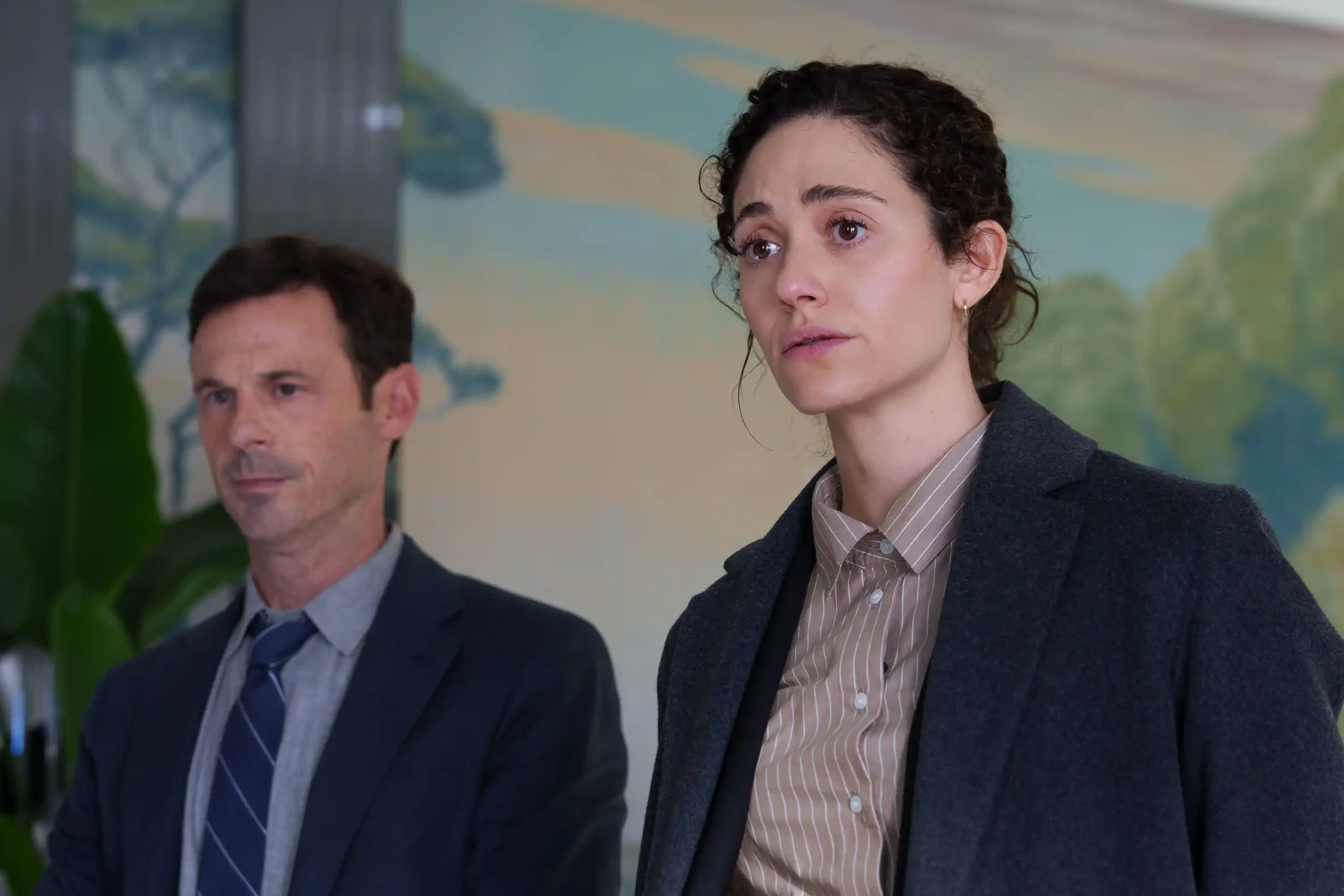
Hulu’s Furious follows two women whose lives become intertwined as they pursue very different versions of justice.
Created by Elizabeth “Liz” Meriwether, the new series stars Emmy Rossum as FBI agent Alice Black, who is tracking a mysterious female serial killer played by Lola Petticrew. As the investigation unfolds, both women are forced to confront the trauma that has shaped them.
In an exclusive interview with BLKCinema.com, Meriwether and Rossum discussed building Alice’s story, researching domestic violence and portraying a relationship that resists easy answers.
Elizabeth Meriwether wanted both women to be survivors
Meriwether said Furious began with another thriller before evolving into something much more character driven.
“The genesis of this project was about the movie Black Widow from 1987, which is a female serial killer and a female FBI agent,” she told us. “And that led to, OK, this story needs to be about two victims of violence and how they’ve taken their experience and gone in two really different directions with it.
She continued, “So I knew that the FBI agent had to also be a victim of violence. And I was really interested in what is the experience of being a woman in law enforcement who is also a victim of violence, having seen the ways that the justice system is flawed when it comes to violence against women and still staying in that job and trying to find justice for other women in the midst of all of that. That felt like a really great, complicated place for a character. And then I tried to just do as much research as I could.”
Research shaped Alice’s journey
To better understand Alice’s world, Meriwether spoke with professionals who work on domestic violence cases. In the series, Alice was previously subject to domestic violence by her husband, Marshall, played by Jake Lacy.
“So I spoke to an assistant district attorney in Brooklyn who focuses on domestic violence and just spoke to her about all the various ways that the system doesn’t work, but the ways that they’re trying to change it and getting a sense of what that was,” she said.
One conversation, she said, highlighted how much complexity can be lost inside the courtroom.
She said, “The way she talked about just as a prosecutor needing to make one person the good guy and one person the bad guy in court and how that there’s often so many more complicated dynamics going on and just a lot of misunderstanding about domestic violence, I think.”
She also pointed to the documentary A Better Man, which follows a former couple revisiting abuse that occurred during their relationship years earlier.
“And then specifically about the Marshall relationship, there’s an amazing documentary, A Better Man, that is about it’s a couple and they film them coming back to talk about abuse that happened when they dated when they were younger,” Meriwether explained. “And it’s really tough to watch, but really interesting because the man is not just immediately vilified. It always seems too easy to me to make people just bad. I feel like you have to dig in and think about why people make choices that they make. And that was really important to me in the Marshall-Alice relationship that we kind of maintained humanity throughout and never let the audience get too comfortable with judgments.”
Emmy Rossum says Alice carries shame over her past
Rossum said Alice’s history affects nearly every part of her life.
“I think specifically for a woman in law enforcement, for Alice, it’s very hard for her to get justice for herself,” she said. “I don’t think she believes that she can or really wants to or has the faith that it would work out. And so there’s a lot of shame about not having pursued justice for herself and also a lot of complicated feelings about her abuser because he wasn’t always just that.”
By the third episode, Rossum said viewers begin to understand just how much history Alice shares with Marshall.
“By the end of the third episode, we realize that he was home of a sort from the time that she was an early teenage girl, that they have a 20-plus-year history of having been in each other’s lives, that there was love there and a kind of family, an alt-family feeling there, that there was chemistry there, that they both went into the same profession,” she said. “So they must have understood the intensity of the job that they both had together.”
Alice is forced to face her past again
Rossum said Alice tries to move on by leaving her detective job for the FBI, only to find herself pulled back into the same relationship.
“And then at points in the relationship, there was also alongside all of that love and that oasis violence and control and oppression,” she said. “And I think that the character has left her detective position, which is not an easy position to earn, and started over at the bottom at the FBI and is hoping that she won’t have to come in contact with that person anymore, that she’s not going to get justice for herself, but she can leave that behind and move and start over. And of course she ends up having to work with that person all over again.”
Rossum said the series also explores how trauma continues to affect Alice long after the relationship has ended.
She explained, “And we see the very real ways in which that history has affected her ability to take care of herself, clean herself, take a shower, and the way that it’s also affected her relationship with her physical self, her disconnection from her own body, her relationship to her own sexuality and the intensity that’s needed there to feel anything.”
‘Two things can be true’
For Rossum, one line in the series summed up the emotional complexity of Alice’s experience.
“So I think it’s an incredibly dynamic and nuanced portrayal that it is one that I found arresting to read and complicated and challenging to hold all of those parts of something,” she said. “That one line is, ‘I miss touching the back of your neck.’ And for me, that just broke me because two things can be true.”
Meriwether said that contradiction is exactly what she wanted the series to examine.
“Love. I mean, love, there isn’t a space for love really in the justice system,” she said. “And that is such a huge part of domestic violence, the complications of being in love with somebody who’s hurting you and what that feels like.”
Featured image photo credit: Disney/Hulu
Leave a Reply