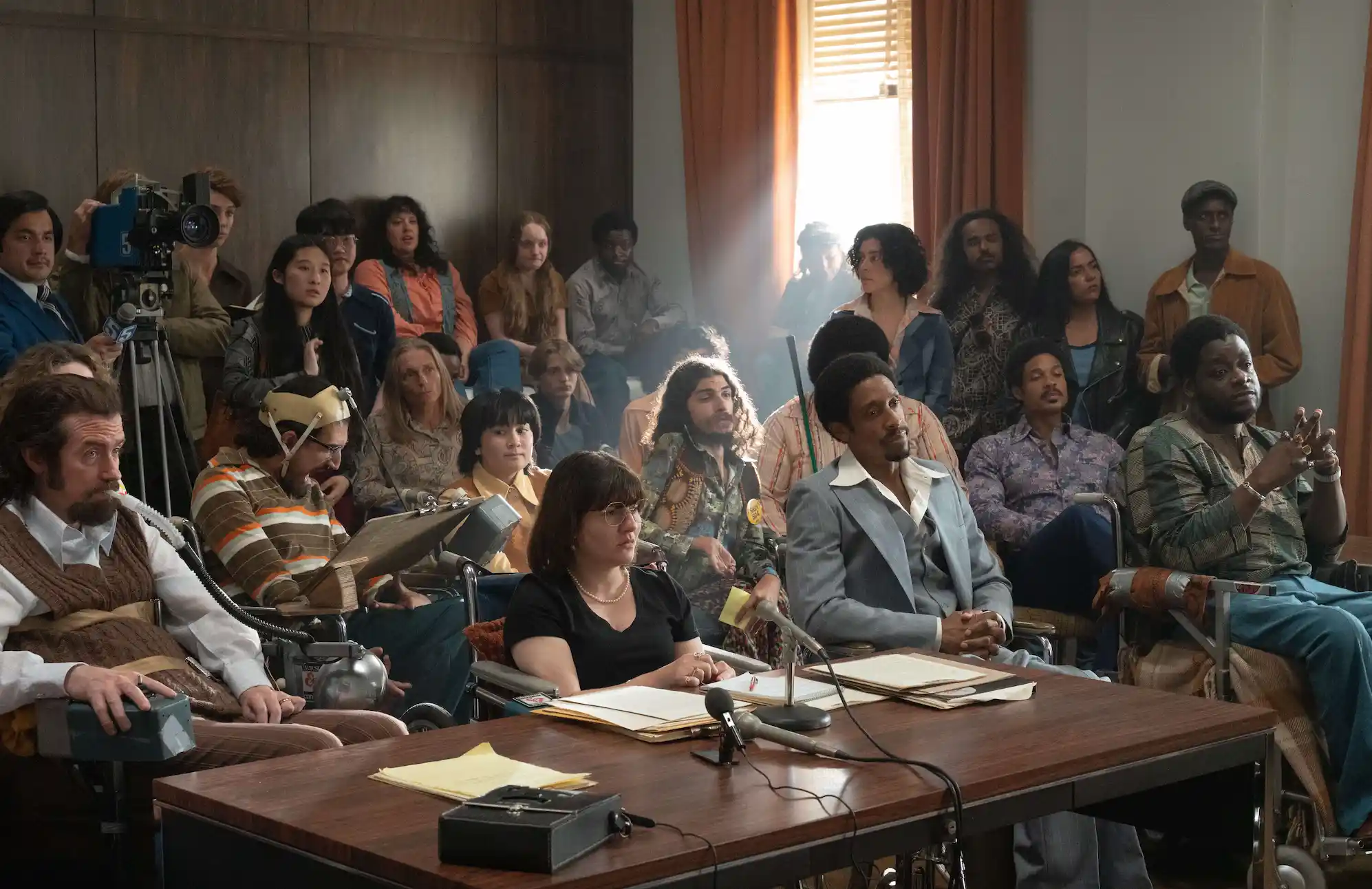
When Siân Heder pitched the new Apple film, Being Heumann, someone pointed out that audiences already know how it ends.
Heder, who previously helmed Apple’s CODA, directs the film about disability rights activist Judy Heumann, played by Ruth Madeley, and the 1977 504 sit-in at a San Francisco federal building. Heder and Madeley spoke exclusively with BLKCinema.com about one of Judy’s defining lines, the fear that surrounds disability and how Heder kept a historical story feeling urgent.
Ruth Madeley on Judy’s refusal to be ‘nice’
Asked about a moment where Judy says she shouldn’t have to be nice to people for them to help her, Madeley said the line struck a personal chord.
“That was one of my favorite lines in the movie, because I’ve very much felt that in my life, that you have to ask for help in a certain way, or you have to be a certain way, in order for somebody to help you,” Madeley said. “For me, the takeaway is, the more disability we see represented, especially on screen, the more people will learn and the less afraid people will feel of it, because I think there’s a lot of fear surrounding disability.”
“The disabled person often takes that on quite a lot, because you know that people are looking at you and are terrified that they’re one day going to be like you, or they don’t know how to interact at all. And disabled people often can’t have a bad day, because otherwise you’re the bitter disabled person who hates life and hates the fact that you’re disabled,” she continued. “I’m like, actually, no, it’s raining and the lift is broke. That’s why I’m annoyed.”
“So I just think general awareness and general understanding, and definitely losing the fear to interact with disabled people, will take a lot of that pressure off both sides,” Madeley added.
Siân Heder on keeping history unpredictable
Heder said the story’s power was never in the outcome.
“I remember when I was pitching the movie and someone said to me, but we know how it ends. And I was like, but you know how Titanic ends too. It’s still really interesting to watch how it went down,” Heder said. “To me, this story wasn’t about what they did. It was about how they did it and what it took. There were so many elements to this story that I was so shocked and surprised by, because I didn’t learn about it in school. I didn’t learn about it as part of our civil rights history.”
“The Black Panthers showed up and fed them, and the gay community in San Francisco came in, and the mayor brought the mattresses, and the FBI shut down the phones, and then the deaf people realized they could sign out the windows and keep communicating,” she continued. “There was incredible specificity and fun and wild details in the story.”
Piecing it together took dozens of conversations with people who were there.
“History is an active, living thing. Just trying to reconstruct what happened in this building, no one could give me a clear answer on how many days they were even in there. Some people said it was 30, some people said it was 23,” Heder said. “I conducted 30-plus interviews with people in the building, and I was most interested in really personal, specific feelings and experiences. I think the thing that makes the movie feel immediate is these moment-to-moment decisions that are happening, for Judy especially. She did not know if she was going to succeed.”
“How she was making decisions, at times acting on impulse and at times being incredibly calculated, and the cat-and-mouse game that they were playing with Califano. He’d make a move, and then they’d figure out what their move was,” she continued. “I hope that people take the ride of the movie, and it’s really fun, and they absorb that instead of it feeling like this is homework.”
Featured image photo credit: Photo: Apple Original Films
Leave a Reply