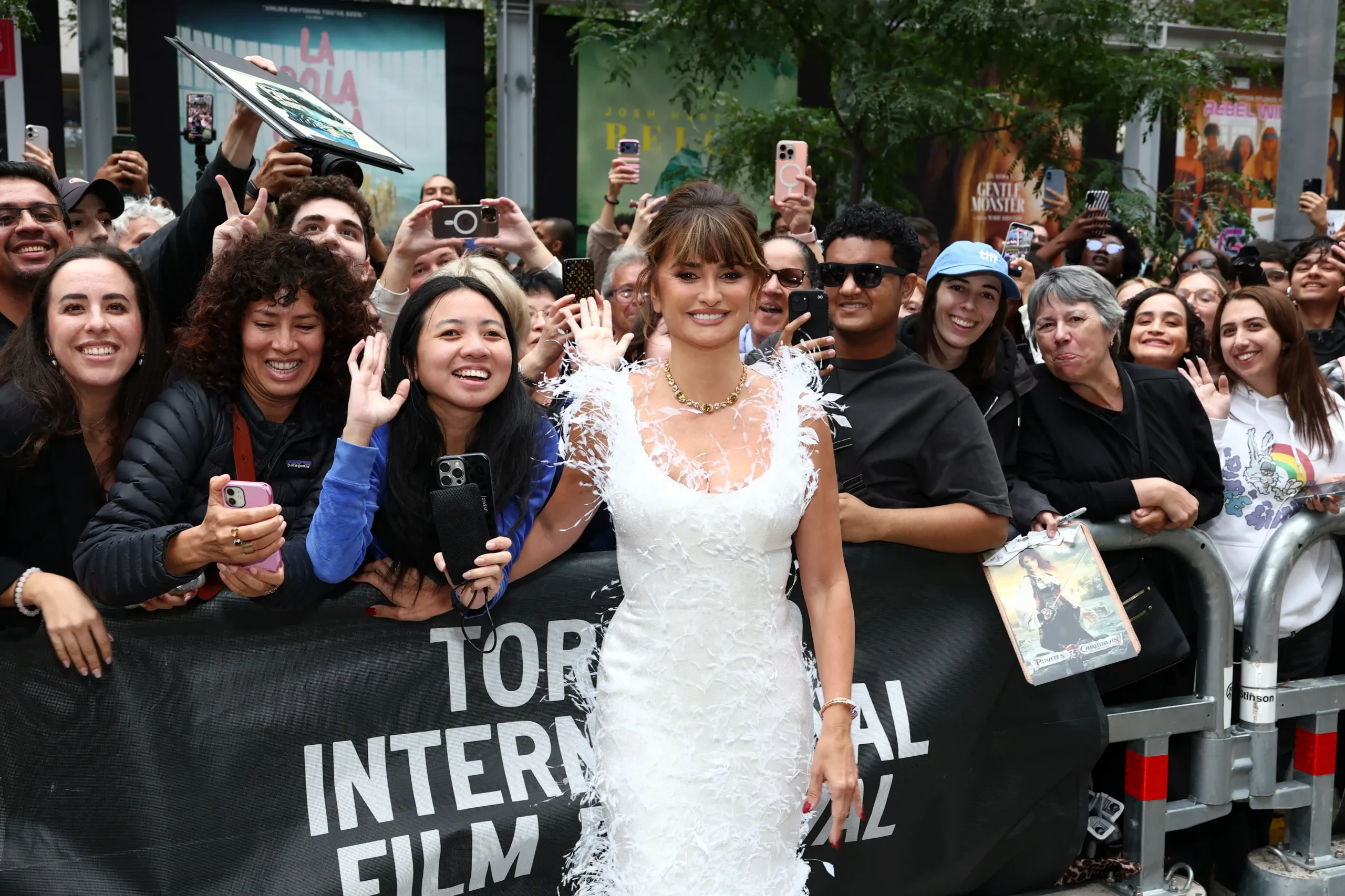
Penélope Cruz discussed her roles in both Netflix’s La Bola Negra and Sony Pictures Classics’ Bunker during a joint, private Toronto International Film Festival (TIFF) press conference, reflecting on stepping into a supporting role for Los Javis’ Cannes-winning drama and returning to singing and dancing on screen.
How did Penélope Cruz get cast in ‘La Bola Negra’?
Cruz said the role came about after she and Los Javis, Javier Calvo and Javier Ambrossi, became close friends before ever working together. “We didn’t know each other very well, and then our agents put together a lunch. And then, we felt like if we were friends. We started to share each other’s secrets. Like, it’s been like that from day one.” She said the directors were initially hesitant to offer her the part, worried it wasn’t substantial enough. “They told me, oh, by the way, we have this character in the movie that we are writing, the one that we going to do next, and we don’t know if we should send to you because it’s not a lead and maybe it’s not big enough for you.”
Cruz said the size of the role was never a factor in her decision. “Never think for a second that I would choose a character based on how many minutes it’s on screen. And they send it to me. I discover a perfect script. I fell in love with the story, with the character of Nené Romero and what she represents.”
What did playing Nené Romero require of Penélope Cruz?
Cruz said the role gave her a rare opportunity to return to dance and singing on screen, something she called both a challenge and a gift. “It gave me the chance to go back to dancing and singing, which is always such a challenge. But I only got the opportunity to do it here and in Nine a few years ago. And I’m always looking for material like that, but it’s so hard to find.”
She described months of preparation for the role’s musical numbers, calling singing in particular a source of genuine fear. “I think it’s where I have felt most vulnerable, and also, the two numbers are very different from each other. And it’s also, how does she speak in real life and how does she speak on stage, which is this character that she has created.” She added that the character’s precise, theatrical speech patterns required specific preparation. “It’s a character inside a character, and it’s the way the cuplétistas speak. It’s a very precise way of speaking. So preparing all of that, I had a lot of fun and, also, a lot of fear. Healthy fear.”
How much of Penélope Cruz’s performance was scripted versus improvised?
Cruz said she and her co-stars stuck closely to the script for most of her scenes, with a few notable exceptions. “We didn’t improvise too much. Some of the dialogue that happens on stage when I’m talking to the soldiers, some of that they would come up with it, like, right in the moment.” She said more improvisation went into scenes involving insults exchanged with an Italian soldier character, but her pivotal scene with Guitarricadelafuente stayed true to the page. “In the scene with Guitarrica, no. That is the way that it was written and it’s, like, music partitura. It’s so well-written.”
What does Nené Romero represent in the film?
Asked about her character’s blend of humor and pain, Cruz described Nené’s stage performances as an emotional survival mechanism. “For her, the escape is the time where she’s on stage. It’s an escape for her to stay healthy mentally, to escape from all the horrors that she’s experiencing for being in a place where she cannot be herself and surrounded by people that cannot be themselves. And in a way, through her singing and through her musical numbers, she’s telling them, let’s have hope because there is a place somewhere and a time where we all will be able to be ourselves.”
She also spoke about why the film’s themes still resonate today. “It’s also sad that La Bola Negra talks about so many issues that are still so relevant today… today, you can see situations like that everywhere. And it’s heartbreaking, but that’s why it is a movie that is so important.” Cruz said the film avoids being preachy while still prompting reflection. “They have managed to do that in a way where they don’t give you a lecture. They don’t tell you how to think, but you are going to leave the theater thinking and asking yourself a lot of questions, no matter what and no matter if you are a 17-year-old or a 90-year-old man or woman.”
How did the film’s message about queer visibility shape Penélope Cruz’s performance?
Asked how Los Javis’ stated intention of honoring the generations who fought for LGBTQ+ rights shaped her approach, Cruz said the value system behind the film wasn’t something she consciously worked to embody. “It’s not something that we talked about. We don’t even think about it. It’s just natural. It’s the way we look at life… The way that, for us, everybody having the same rights is not something questionable. It’s just the way it is and it’s the way it should be for everybody.”
She credited Pedro Almodóvar, a longtime collaborator, with shaping that worldview throughout her career and life. “I’ve been shaped in that way for the fight for respect that Pedro has been the leader of for all of his life… I just don’t conceive any other way of seeing the world, of thinking that somebody would deserve less respect because of that. It cannot cross my mind, that thought.”
Featured image photo credit: Photo: Cindy Ord/Getty Images for Netflix
Leave a Reply